Has Your Business Ownership Changed?
A Business Ownership Change Can Create Insurance Gaps
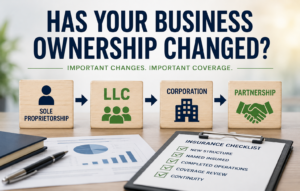 Business ownership change happens a lot these days. You may convert a sole proprietorship into an LLC. An LLC may become a corporation. A partnership may become an LLC. You might even purchase another company or bring in new owners.
These changes are often made for tax, legal, operational, or growth reasons. However, many business owners overlook one critical step after making the change.
They forget to call their insurance agent.
That oversight can create significant coverage issues. In some cases, it can even lead to claim disputes when coverage is needed most.
If your business ownership or legal structure has changed, your insurance policies should be reviewed immediately. The legal entity listed on your insurance policy matters more than many business owners realize. The named insured should accurately reflect the legal entity that owns and operates the business.
Why Does a Business Entity Change Affect Insurance?
Many business owners assume their insurance automatically follows the business.
Unfortunately, insurance doesn’t always work that way.
A sole proprietorship, partnership, LLC, and corporation are separate legal entities. Even if the business name stays the same, changing the legal structure can create a completely different insured entity from an insurance standpoint.
For example:
- John Smith DBA Smith Landscaping
- Smith Landscaping LLC
- Smith Landscaping, Inc.
These may appear identical to customers. However, from a legal and insurance perspective, they are different entities.
If the wrong entity is listed as the named insured, claims can become complicated. In some situations, coverage could be challenged because the policy does not properly insure the business that owns the operations.
What Types of Business Changes Require an Insurance Review?
Many ownership and entity changes should trigger a conversation with your insurance professional.
Common examples include:
Sole Proprietorship to LLC
Many businesses begin as sole proprietorships and later form LLCs for liability protection.
While this is a smart business move, the insurance policy may still list the owner individually rather than the newly formed LLC.
LLC to Corporation
As businesses grow, they often convert to S-Corporations or C-Corporations.
The corporation becomes its own legal entity and may require policy updates.
Partnership to LLC
Partnerships frequently restructure into LLCs.
Ownership percentages may change, and new members may need to be addressed on insurance policies.
Corporation to LLC
Businesses occasionally simplify operations by converting from a corporation back to an LLC.
The insurance program should reflect the new structure.
Adding or Removing Owners
Even if the entity remains the same, adding partners, members, or shareholders may affect underwriting and coverage considerations.
Business Acquisitions or Mergers
Purchasing another company or merging entities can create substantial insurance implications.
Additional entities may need to be named, and prior operations may require protection.
What Is a Named Insured and Why Is It Important?
The named insured is the person or entity specifically listed on the insurance policy.
This designation determines who receives protection under the policy and who has rights under the contract. The named insured should generally be the legal entity that owns the business and faces liability exposure.
If your business structure changes and the policy remains under the old entity, problems can arise.
Examples include:
- Claim delays
- Coverage disputes
- Contract compliance issues
- Problems obtaining certificates of insurance
- Potential claim denials
The goal is simple.
The entity operating the business should match the entity insured by the policy.
What About Completed Operations Coverage?
This is where an experienced commercial insurance professional becomes extremely valuable.
Many business owners focus only on future operations after a business change. However, what about work completed before the ownership or entity change?
Imagine this scenario:
ABC Plumbing LLC performs a major installation project in 2024.
In 2025, ABC Plumbing LLC converts to ABC Plumbing, Inc.
In 2027, the installation fails and causes significant property damage.
- Which entity performed the work?
- Which entity is being sued?
- Which insurance policy should respond?
Those questions become very important when completed operations claims arise after a restructuring. Changes in corporate form and legal entities can affect insurance coverage if not properly addressed during the transition.
Your insurance advisor should review:
- Prior operations exposure
- Completed operations liability
- Policy continuity
- Successor liability concerns
- Entity transitions
- Potential coverage gaps
Every situation is different. The correct approach depends on the structure of the business and the nature of the change.
Could the Old Entity Still Need Protection?
Absolutely.
One of the most overlooked issues after a business restructuring is protecting the prior entity.
Even if the old entity no longer actively operates, claims may still arise from work performed years earlier.
This is especially important for:
- Contractors
- Manufacturers
- Service businesses
- Consultants
- Repair companies
- Installation companies
Past work does not disappear simply because the business structure changed.
A knowledgeable commercial insurance professional will help determine whether the former entity should remain protected and how to address ongoing exposures from prior operations.
What Other Insurance Policies May Need Updates?
Entity changes often affect much more than general liability insurance.
Your agent may need to review:
Commercial Property Insurance
Property ownership may change between entities.
Commercial Auto Insurance
Vehicles may need to be titled or insured under the correct entity.
Workers’ Compensation
Ownership changes frequently require updates with workers’ compensation carriers and rating organizations.
Umbrella Liability
Underlying policies and named insureds should align properly.
Professional Liability
Professional services performed under prior entities may require special consideration.
Cyber Liability
Business operations and legal ownership should be accurately reflected.
Directors and Officers Liability
Corporations and certain LLCs may have additional management liability exposures to consider.
What Questions Should Your Insurance Agent Ask?
A strong commercial insurance advisor should go beyond simply changing the name on the policy.
They should discuss questions such as:
- When did the ownership change occur?
- What was the prior entity?
- What is the new entity?
- Did ownership percentages change?
- Were any assets transferred?
- Were liabilities assumed?
- Was another company acquired?
- Are there prior completed projects that remain exposed?
- Should multiple entities be insured?
- Are contracts affected by the change?
These conversations help identify potential gaps before a claim occurs.
Why Business Owners Should Act Quickly
Insurance companies generally want accurate information regarding ownership and business operations.
Waiting months to notify your insurance carrier can create unnecessary complications.
The sooner your insurance professional reviews the change, the easier it is to determine:
- Whether endorsements are needed
- Whether a new policy is required
- Whether prior entities need protection
- Whether contracts need updating
- Whether coverage remains adequate
A quick phone call today could prevent a major problem years down the road.
How Huff Insurance Helps Business Owners Navigate Ownership Changes
Business ownership changes can be exciting. They often signal growth, opportunity, and long-term success.
However, they can also introduce insurance challenges that many business owners never see coming.
At Huff Insurance, we help business owners understand how entity changes affect their insurance program. We review ownership transitions, named insureds, completed operations concerns, liability exposures, and policy structure to help identify potential coverage gaps before they become costly problems.
Since 1960, Huff Insurance has served businesses as an independent insurance agency. An independent insurance agent represents multiple insurance companies rather than just one carrier. This allows us to compare options and help find coverage solutions that fit your business’s unique needs.
If your business ownership has changed recently—or if you’re planning a change soon—contact Huff Insurance before the paperwork is finalized. A simple review today can help protect your business tomorrow.
Frequently Asked Questions
Does changing from a sole proprietorship to an LLC affect my insurance?
Yes. A sole proprietorship and an LLC are different legal entities. Your insurance policies should be reviewed to ensure the proper entity is listed as the named insured. Failing to update the policy could create claim complications later.
If my business name stays the same, do I still need to notify my insurance agent?
Yes. Even when the public-facing business name remains unchanged, a change in legal structure can affect insurance coverage. The named insured on the policy should accurately reflect the legal entity operating the business.
Can my old business entity still be sued after I change structures?
In some situations, yes. Claims can arise from work completed before the transition. This is especially common with completed operations exposures where damages occur months or years after the work was performed.
What happens if I add a partner or investor?
Adding owners can affect underwriting, liability exposures, and policy structure. Your insurance professional should review the change to determine whether updates are needed.
When should I contact my insurance agent about a business ownership change?
Ideally, before the change becomes effective. Early planning allows your insurance professional to identify potential issues and help maintain proper protection throughout the transition.
Final Thoughts
A business ownership change is much more than a legal or tax decision. It can have a significant impact on your insurance coverage.
Whether you’re moving from a sole proprietorship to an LLC, converting to a corporation, adding partners, or acquiring another business, your insurance program should be reviewed immediately.
Don’t assume your existing policy automatically follows the change.
Talk with a trusted commercial insurance professional who understands entity transitions, completed operations exposures, and long-term liability concerns.
Your future self will be glad you made the call.
About The Author: Jerry Nicklow
Jerry Nicklow has worked in the insurance industry since 1995 and has written insurance marketing and educational content since 2008. He holds the API, AAI, and AIS designations from the Insurance Institutes. He has also appeared on insurance industry podcasts, and is the creator of Real Insurance Talk, where he explains insurance in plain terms through articles and his YouTube channel to help individuals and business owners better understand coverage and risk.