Protecting Lifestyles

Protect Your Assets And Income
From Disasters And Lawsuits!

Request a Quote

The Kitchen Is A Dangerous Place, Even For Adults!

Kitchen Fire Safety

Study Shows Adults Aren’t Always Careful When Cooking At Home

Kitchen Fire, Fire Safety, Huff Insruance, Pasadena MD

The National Fire Protection Association (NFPA) reports that between 1999-2002, there were an average of 114,000 home fires associated with cooking equipment each year, resulting in 290 deaths and 4,380 injuries each year. The leading cause for these fires was unattended cooking.

In fact, three in 10 reported home fires start in the kitchen, and two out of three reported home cooking fires start with the range or stove. Believe it or not, electric ranges or stoves have a higher risk of fires, injuries and property damage, compared to gas ranges or stoves. However, gas ranges or stoves have a higher risk of fire deaths.

Because of these alarming statistics, The Hartford decided to commission Harris Interactive to create an online study of adults’ cooking habits to examine what factors were contributing to kitchen fires. The researchers questioned 2,527 adults, aged 18 and over during October 2006. Two hundred forty-three of those surveyed lived with at least one child under the age of five.

The study revealed questionable cooking habits that could increase the risk of cooking-related fires:
Fire Safety, Kitchen Fires, Huff Insruance

  • Seventy-eight percent of those polled reported leaving an appliance such as a microwave, oven, or range unattended while cooking
  • One in five respondents reported leaving their house while the appliance was running
  • More than one-third of the respondents didn’t keep a fire extinguisher in the kitchen.

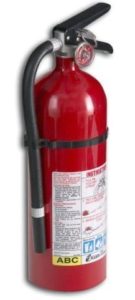
These statistics are alarming to say the least.  And you should always keep a fire extinguisher in your kitchen.  And make sure it is one designed to be used in the kitchens and can be used for grease fires.  It will be clearly marked on the extinguisher or packaging.  The researchers noted that the overwhelming majority of respondents didn’t seem to know the safety rules to follow when preparing food at home.

Follow these NFPA Guidelines in your kitchen:

  • Kids and pets should stay at least 3 feet away from the stove while cooking.
  • Keep an eye on the stove top while frying, grilling, or boiling food.  And Never walk away from food while it is cooking on the stove top.
  • Items that can ignite easily, such as dishtowels, curtains, or paper towels, are remain at least 3 feet away from the stove.
  • Potholders or oven mitts should be within easy reach.
  • Pot handles should be turned in toward the back of the stove to prevent spilling.
  • If someone gets burned, pour cool water over the burn for 3 to 5 minutes.
  • Be careful when removing cooked food from a microwave, because the hot steam can cause burns. Children should never use a microwave unless an adult gives them permission.

Can Your Business Be Sued For Retaliation?

Can getting rid of a employee get you sued?

The answer is Maybe!

This blog ties in nicely with last weeks blog on EPLI  (Employment Practices Liability Insurance)

If you’ve been considering firing an employee who’s been giving you headaches about workplace safety, you might want to hold off on issuing the pink slip. This is the painful lesson learned by one Arizona-based trucking and transportation company, M3 Transport/SLT Expressway.

One of their drivers was directed to make a run with a co-driver who was a smoker. He found a whole bunch of cigarette butts in the co-driver’s truck. The problem: The cargo was explosives.

Smoking while hauling explosives, the driver pointed out, was a violation of HAZMAT regulations.

The company sent him home after pointing this out, and then fired him two days later.

Bad move

The employee complained to the Department of Labor.  They directed the company to pay more than $200,000 in back wages, $15,000 in interest, and punitive damages of $20,000. It would have cost them a lot less to to find a non-smoker who was willing to make the trip.

OSHA also directed the company to post information on workers’ right to raise workplace safety concerns without having to fear retaliation on the part of the employer.

In this particular case, the company specialized in hauling explosives for the military. So, it’s easy to conclude that they should have known about the regulation forbidding smoking on explosive hauls.

Another case involving a trucking company: A driver for Interline Logistics Group LLC in Sauk Village, IL, informed his central office about a brake problem on his truck. The company instructed him to take the truck to a mechanic to have it checked out. Then dispatch instructed the driver to pick up another load. The driver refused, stating that he was already over the number of work hours allowed by law.

The company fired the driver the following day – for failing to follow the (illegal) instructions of the dispatch office.

Again, the driver complained to OSHA, which investigated, and found Interline Logistics Group culpable. They directed the company to rehire the driver immediately – and pay him $190,000 in back wages, citing the anti-whistleblower provisions of the Surface Transportation Assistance Act.

In a separate case, an employee accused Party Rental Enterprises, Inc., dba Able Linen Service, of firing him for raising objections over a workplace safety issue. OSHA attempted to contact the employer, but the employer was not responsive to numerous attempts to contact them.

The problem did not go away by ignoring it: The worker and OSHA secured a default judgment against the employer. A judge directed the company to pay $17,000 in back wages against the company, plus an additional $20,000 fine.

Lessons Learned

The first lesson learned is that firing employees solely on the basis of whistleblowing does not pay off. If the employee complains and the matter gains any traction or goes to court, the whistleblower receives the benefit of any doubt. The burden of proof falls on the employer, in these cases, to demonstrate based on the preponderance of the evidence that the firing was justified – and for reasons wholly unrelated to the whistleblowing. The laws make it very difficult for employers to fire whistleblowers, so even if you are firing them for other reasons, you need to make sure that your documentation is very strong.

Documentation is therefore the key to protecting your interests – and that goes for employers and employees alike. If you don’t have a record of documentation for disciplinary infractions – ideally predating the incident under review – then you have an uphill battle in court if it comes to that.  Make sure that all incidents are documented in writing at the time and date they occurred.  Documenting multiple previous issues at a later time does not stand strong in a court of law.

Likely, documentation becomes the employee’s friend. For example, truckers with safety or maintenance concerns over their employer’s vehicles should be diligent in filling out their daily vehicle inspection (DVIR) reports. These reports become the employee’s friend, in court, if the vehicle problems were documented ahead of time, and if the employee has a track record of being diligent about reporting vehicle maintenance problems.  Employees generally do a better job documenting their file than some employers.  Don’t let this happen to you.  Make sure that all logs and vehicle’s maintenance records are maintained along with employees disciplinary issues.   In order to be protected if these issues arise in the future, in addition to documentation, you need employment practices liability insurance.


Person using a laptop during a virtual meeting, illustrating remote work and digital workplace practices related to Employment Practices Liability Insurance | EPLI | Huff Insurance

Things You May Not Know About Employment Practices Liability Insurance (EPLI)

Do You Know What EPLI Is?

Employment Practices Liability Insurance (EPLI)EPLI is an abbreviation for Employment  Practices Liability Insurance. This type of insurance coverage protects businesses against claims made by workers that the company is violating their rights as employees.

The number of lawsuits filed against employers by employees has been rising considerably in recent years. Although the majority of lawsuits are filed against larger companies; no business should assume immunity from such incidents. Many companies are adding employment practices liability insurance to their business insurance policies. An endorsement on a BOP (Business Owners Policy) alters the conditions and terms  You can still purchase EPLI as an individual insurance policy instead; the coverage is generally broader and higher limits of coverage are available.

EPLI offers protection for several types of claims, including:

  • Discrimination
  • Employment Contract Breaches
  • Sexual Harassment
  • Wrongful Discipline
  • Promotion Failure
  • Employment Failure
  • Wrongful Termination
  • Wrongful Emotional Distress
  • Employee Benefit Mismanagement
  • Career Opportunity Deprivations
  • Negligent Evaluation

The cost of employment practices liability insurance is not the same for all businesses. The cost of EPLI  depend on the number of employees, the type of business and the history of the business. For example, a company that has faced these types of  lawsuits in the past would have a higher cost than a company with a clean record. Multiple lawsuits put companies in a much higher risk category.  Also, the turnover of employees affects the premium as well.

What Will An EPLI Policy Do For Your Business?

Employment practices liability insurance will reimburse companies for their court fees, judgment amounts and legal defense costs. Legal costs are covered regardless of whether the company wins or loses. If civil criminal fines or punitive damages are included in the incident, the policy will not cover either one. EPLI policies do not cover liabilities that are covered in other types of policies (Like a general liability insurance policy).   All companies should work with their managers and employees to minimize problems in the workplace. To make the company an optimal place to work the managers need to address issues and discuss the issues with employee.

Hiring Practices Are Important!

Companies should form good screening and hiring habits when it comes to adding new employees. This will help them avoid possible discrimination lawsuits. To make sure employees are aware of the company’s policies against negative practices, place posters in high-traffic areas of the workplace. Employers should have written policies about discrimination, internet usage and harassment.  These posters should clearly outline the company’s policies. It is also helpful to send policies to employees via email or written correspondence periodically.

In addition to this, the policies should be included in employee handbooks and training manuals. If employees experience problems, they should know what to do next. For example, if an employee is the object of sexual harassment, he or she should know how to report the information and who is in charge of reviewing such reports. Any relevant incidents should be clearly documented by the company.  It is important to work quickly when these issues arise.   For more information about this type of coverage, give us a call.


Your Driving Record and How It Effects Your Auto Insurance Premium

How Does Your Driving Record Affect Your Auto Insurance Premiums?

Auto Insurance, Huff Insurance, Pasadena MDDid you know that your auto insurance company has the right to review your driving record at any time?  Typically, they’ll review your driving record when you apply for coverage and when they issue a renewal offer for your car insurance policy.  This is to evaluate your risk potential, or determine if you are insurable at all.

Generally, what the auto insurance company will analyze are the incidents that are reported on your driving record.  When found guilty of a traffic violation (moving violations, parking tickets, at-fault accidents, etc.), the violation then appears on your driving record.  The more violations you accumulate, the worse your record. The violations on your driving record may or may not affect your auto insurance rate since each car insurance company has their own way of evaluating violations.

Car Insurance Companies  typically evaluate your violations using their own system to determine the amount of your rate increase (if your rates increase at all).  Most auto insurance companies, however, use a Safe Driver Insurance Plan, which lists the different types of violations and assigns a points value to each one, based on the severity of the incident.  Under this plan, as you accumulate points, your car insurance rates are subject to increase or to a non-renewal of your policy.

Your driving record isn’t the only information your auto insurance companies can use to underwrite your car insurance policy.  In most states, including Maryland, Auto Insurers can also use credit scores to determine rates. If you have a good credit score, your rates are likely to be lower than someone with a bad credit score. Auto insurance underwriters perceive a direct relationship between your credit score and the chances of you filing a claim.

Your auto insurance company can also us a CLUE (Comprehensive Loss Underwriting Exchange) report to underwrite your auto insurance policy.  Almost all car insurance companies report all of their claims activities to CLUE.  So when you apply to a new auto insurance company, they pull this CLUE report to verify the number of past accidents that you have been involved in.


Animated shopping bags with 'DISCOUNT' labels showcasing Huff Insurance in Pasadena, MD's auto insurance savings

Available Auto Insurance Discounts To Reduce Your Premiums

Paying Too Much for Auto Insurance?

Do you know about all of the available discounts available for your auto insurance? Like the Following:

  • Telematics Discount
  • Defensive Driving discount
  • Good Student Discount
  • Good Driver Discount
  • Multi-Policy Discount
  • Safety Feature Discounts
  • Anti Theft System Discount
  • Low Mileage Discount

Personal automobile insurance can be expensive, but did you know that auto insurance companies offer discounts that can save you serious money?  Ask your independent insurance agent about the many types of auto insurance discounts available. Keep in mind that not every discount listed below is available in every state or with every carrier:

Telematics Discount

The telematics auto insurance discount is becoming very popular these days.  This discount can range from 5% to 50% for each driver on your policy.  How does it work?  The auto insurance company will use an app on your phone to track your driving habits.  Some of the items they track are as follows:

  • Hard Braking
  • Quick Acceleration
  • Time of Day Driving
  • Driving Location (not all carriers monitor this)
  • etc.

Defensive Driving Discount 

Reduce your risk of accidents by taking a defensive driving class, and many auto insurers will give you a discount on auto insurance premiums. These courses usually last from 5 to 6 hours and train you to recognize road hazards and how to react in enough time to prevent accidents. The fee is about $20.00, but successful completion can earn you a 3-year, 10 percent discount on liability, medical payments and collision coverage.

Good Student Discount

Who ever said that good grades don’t pay off?  Earn good grades in school and your carrier may reward you. That’s because statistics show that good students make better drivers because they are more mature and reliable. Many states allow a 5 to 10 percent discount if your student driver makes good grades, usually an overall “A” or “B” average in high school or college.  So get a copy of the report card and send it in to your auto insurance agent.

Good Driver Auto Insurance Discount

Keep your driving record clean and you can save money on your auto insurance. If an insurance company’s risk is lowered, it will pass the savings on to you.

Home/Car Bundle Discount (or Multi-Policy Discount)

Purchase both your homeowners insurance and automobile insurance from the same carrier, and you may receive a discount of 10 percent or more, which will lower the premiums on both policies.

Multiple Car Discount

Insure two or more cars with the same carrier, and you may be eligible for a discount on both cars’ coverage.

Model-Related Auto Insurance Discounts

Buy a car that has been assigned a high safety/anti-theft rating. Industry agencies rate every car model based on its collision history and the number of injury and theft claims associated with it. The higher the rating, the more probability of insurance premium discounts. Choosing a car with a lower rating can significantly raise a premium because of the higher risk factor.  So keep this in mind when deciding on whether or not to buy that high performance sports car…

Protection from Physical Damage/Theft

Choose options that protect your car from physical damage and theft, and you may receive a discount. Many insurers reward consumers who reduce risk by opting for anti-lock brakes, airbags, alarm systems and other security devices.

Low-Mileage Discounts

If you have a car that is used for limited miles each year, your carrier may offer you a discount. That’s because the less time the car spends on the road, the less of a possibility there is for an accident.


Hiring a Nanny – Know and Manage Your Risks

Things to consider when hiring a Nanny

Many working parents have had their various issues and complaints with commercial and private daycare and childcare centers. As an alternative, more and more parents are choosing to hire their own nanny or share one with another parent. However, many parents aren’t fully aware of the many financial risks involved with bringing a nanny into their home.

Here are some things to consider when faced with the decision to hire a nanny:
Hiring a Nanny, Huff Insurance, Pasadena MD

  • Payroll Taxes
  • Injury on the job for the nanny
  • Hire your own or use an agency

Hiring a Nanny Makes you An Employer

When you hire a nanny, you’ve basically just become an employer. Did you know that your new nanny could cause you IRS problems if you improperly pay him/her and not withhold payroll taxes? Even if you withhold payroll taxes, you can still find yourself facing some costly penalties and fines if they aren’t calculated correctly and submitted on time. One way to eliminate this risk is by hiring a payroll provider to appropriately handle the taxes, just as any other employer would do.

What If You Nanny Gets Hurt On The Job?

Another financial risk is being sued by your nanny following an injury on the job. What if the nanny hurts her back while lifting your child and cannot work for a substantial amount of time? This risk of injury is why it’s prudent to purchase worker’s compensation insurance. Otherwise, you’d be responsible for paying all the benefits that your nanny would’ve received under such a policy and any penalties or fines that your state might impose. Before you falsely assume that your nanny’s injury would be covered by your umbrella insurance policy or homeowner’s insurance policy, it won’t. These policies typically exclude any injury where workers’ compensation would normally be due to the injured party.

However, you will need an umbrella insurance policy that includes excess employer’s liability insurance coverage beyond that provided by worker’s compensation coverage. Your nanny’s spouse, children, or other family members could initiate a lawsuit for loss of his/her services if your nanny is injured on the job. Employer’s liability insurance coverage is provided under workers’ compensation insurance coverage, but lawsuits of this nature can easily exceed the limits.

One final concern would be from another parent’s child being injured while under the care of a nanny while at your home. Even if the parent was involved in the vetting and hiring process of the shared nanny, you could still be sued by them for the child’s injury. If you share a nanny with another family, then you’ll want to ensure that your personal umbrella insurance limits are high enough to adequately protect your assets.

Do you want to use an agency?

If you want to avoid all the liabilities and insurance concerns, but still have the benefit of a personal nanny, then you might consider using an agency nanny. When you hire a nanny through a service or agency, the nanny is their employee, not yours. This puts the responsibility of payroll taxes, insurance coverage, background and reference checks, and so forth on their shoulders, not yours. Some agencies will even have added perks, such as having an equally qualified nanny on standby for times when your regular nanny isn’t available. Considering that you can avoid the countless hours interviewing nannies, potential liability risks, and the need for various costly insurance policies, the additional fees associated with a nanny service may be well worth it to you in the long run.


Why You Should Require Liability Insurance for Those You do Business With

Are the people you do business with insured? You may want to ask them (And Ask For Proof).

If a vendor, contractor, cleaning crew, gardener/arborist, or other service provider does not have insurance, you may be out of luck if they cause property damage or injury. Also, people who do not carry insurance are probably less likely responsible than those who are insured. They may not be the ideal people you would want to hire. It’s worth paying a little more to get someone who is insured.

Never just take the word of a vendor. Many who are not insured may say “yes” because it’s likely they don’t want to embarrass themselves. Instead, ask them to have their broker send a certificate of insurance. By having their broker send (fax or email) it to you, you know the policy has been paid for and has not been cancelled.

Some vendors, especially small firms, will try to convince you that they do not need insurance. Do not fall into this trap as you will be letting an amateur convince you to purchase product or service that lacks the protections an insurance policy provides. As a courtesy to existing clients, we can give you advice on any insurance certificate that is emailed or faxed to us.

Suggestions on who you should request insurance certificates from:

  • Contractors who are working on a home or commercial remodel
  • Repair or installation service for your auto, home, or business
  • Service contractors, such as gardening and maids/cleaning services
  • Independent Contractors or Contract Employment
  • Professional Services, such as such as a CPA, Consultant, Mortgage Broker, Staffing Firm, Insurance Broker, Architects/Engineers, and others who provide professional services (professional liability)
  • People who rent or lease from you (whether a business in a commercial property you own, or a resident in a residential property tat you own)

Types of Insurance you should request:

Should you request a certificate for every purchase? It’s your call, but if someone is entering your premise or you are purchasing a bigger ticket item, you should strongly consider asking for insurance documentation.

When Should You Get Car Insurance for Your Teen?

Your Teen is Starting to Drive.  Now What!

When should you get car insurance for your new teen driver?

Allie Nicklow, Teen Driving and Auto Insurance, Huff InsuranceAs soon as they start learning to drive, whether they are starting with a learner’s permit or going straight to the license, you should inform your auto insurance company to have them added to your policy.  This is the best way to provide the best protection for your assets and usually much more cost-effective than placing them on their own policy, especially if you are a safe driver with a clean record.  Depending on your auto insurance company, they may nor may not rate them while they have their learner’s permit.  Some companies may not charge a premium for the the new driver until they get their full driver’s license.  But the main point here is to inform your company that your teen is starting to drive.  Failing to do so can be determined as a material misrepresentation and cause problems should their be a claim.

Statistics show that teens are more prone to auto accidents than those in other age groups, so starting out with the right amount of auto insurance coverage is extremely important.   Plus, it is also important to have them added as a driver on your umbrella insurance policy as well.  Because if they are involved in an auto accident while living with you, you most likely will be a party to a lawsuit as well.

When your child goes away to college, unless they are taking a car with them, you will probably want to switch them to “occasional drivers” under your policy.  Some other considerations:

  • You may qualify for a multi-vehicle discount if your child’s car is covered under your policy.
  • You may also qualify for a discount during the time your child is away at college (usually 100 or more miles away without a vehicle).
  • Encourage your child to earn good grades, and take a driver training course.  Some insurers offer a nice discount due to good grades, and for completion of training courses.
  • Serve as a good role model; your child will learn by example, so it is important to demonstrate good driving habits early on (i.e. not texting or talking on the phone, using seat belt, not drinking and driving.)

For more information, please check out our research page on Teen Will Drive Soon.


Does a Homeowners Insurance Policy Cover Your Home-Based Business?

How do you properly insure a home based business?

With both technology and the internet, more and more people are running home-based businesses, either full-time or part-time. But will a homeowner’s insurance policy cover the risks of a home-based business? In nearly every case, the answer is no. The only exception to this might be if a homeowner’s insurance policy has a special endorsement, such as an endorsement to run a day care operation from your home. (And even then, it may be better for you to get a separate Daycare Insurance Policy) Yet fewer and fewer insurance companies offer such endorsements. Additionally, some home insurance policies may give a very limited amount of coverage for business property, such as a computer. The bottom line is, nearly all homeowners insurance policies clearly exclude business operations and not having a proper coverage in place can leave you with uninsured exposure. This is why you need separate business insurance to cover your home-based business risks.

Home-based business owners may feel that they do not need insurance coverage because nobody steps foot on their premises. The problem is that liability claims often happen away from the business premises. This can include a number of scenarios, including someone taking action for information on your website or someone getting injured from the product or service you provide. Most business insurance policies include coverage for personal injury lawsuits, which means someone takes legal action against you for things like libel or slander. Competitors and customers both can sue a business owner for personal injury. A business liability insurance policy also covers off-premises injury, such as if someone trips on, slips on, or is injured by any kind of property you take out in the field. It will also cover you during trade shows and usually meets the insurance requirements that some trade shows may require.

From a property standpoint, any business property you may have in your home is usually excluded or has very limited coverage under a homeowners insurance policy. Getting a business property insurance policy to protect your computers, equipment, furniture, inventory and any other physical assets helps keep your business in operation with minimal disruption and financial loss. A business insurance  policy also usually covers loss of income, which is payment for income you did not earn as a result of a loss covered under your policy. Policies may also include coverage for things like valuable papers, damage to property of others, property coverage off-premises and a number of other additional coverages.

A business owner’s policy includes the coverage described above, and is specifically designed to protect the unique interests and property of a business owner. This insurance package policy includes nearly all, if not most, of the coverage you need. However, if you are providing some kind of professional advice, consulting, or other non-tangible professional services, you may also need a professional liability insurance policy. This is also known as Errors & Omissions Insurance. In addition, if you have any employees, you are probably required by law to get Worker’s Compensation Insurance. Depending on the type and size of business you own, you may have further insurance needs.

Hoping that your homeowner’s insurance policy is going to cover you in the event of a claim will leave you frustrated if your business experiences a loss. Businesses have a much higher risk than a homeowners insurance policy allows for, and homeowners claims adjusters will quickly deny coverage for business-related claims in the event of a loss. Talk to a Trusted Choice Independent Insurance Agent today to explore your business insurance needs and options.


Intellectual Property Liability Is Everywhere – But Where Is The Insurance Coverage?

Intellectual Property Insurance Coverage

It seems as though virtually anything created can be patented, copyrighted, trademarked or otherwise protected.  Oddly enough, even with patent protection there is danger. It is easy to believe that if you hold a patent, copyright or trademark you cannot possibly infringe on someone else’s intellectual property – but that’s not true. George Harrison certainly had a copyright on his song “My Sweet Lord” but that didn’t prevent highly publicized and successful litigation against him due to its similarity to the old Shirelle’s hit “He’s So Fine” in the 1970’s.

With an average cost of $1.2 million to litigate, patent infringement trials weigh in as one of the most expensive types of litigation in the US today.  What was once the realm of the individual like Ben Franklin or Thomas Edison, or the very nearly individual (think Wright Brothers), has now become big business.  IBM, which annually tops the list of companies applying for and receiving patents, has received over 22,000 patents from 1993 to 2002, with patents accounting for about $10 billion in royalties during that ten year period according to the company’s website.  Complicating matters is the relatively recent innovation in its own right of the “Business Method Patent.”   Examples of these controversial patents are Amazon’s Internet shopping cart, or the “reverse auction” process that Priceline created and patented.

Contrary to popular belief, however, intellectual property is not the patent or copyright that one applies for, but rather the idea behind it.  The registration process, be it copyright, patent, or other method, is merely a form of evidence or proof of the origin of the idea, and its timeline.   The piece of paper that one might receive acknowledging a copyright is merely a statement that the Office of Copyrights has not received anything else prior to the submission of the material that resembles it enough to call into question the authenticity of the work.   Conceivably, one may apply for and receive a copyright or patent for a piece of work and yet be sued.  But where’s the insurance coverage you say?  Good question.  The answer is – it depends.

Take the Recording Industry Association of America’s litigation against numerous individuals in the summer of 2003.   Would your homeowners’ insurance policy apply if you were sued for negligent supervision of your teenager leading to the illegal uploading of music to the Internet?  The answer is probably “no” because there is no bodily injury or property damage (theft of intellectual property is unlikely to be perceived as a form of property damage), and the insurance policy is not designed to respond to pure financial loss claims.   So in a personal sense, you are probably out of luck.

For businesses the news is not as grim.  In a business scenario, the General Liability Insurance Policy has often been called upon for coverage in patent, copyright and trademark infringement cases.   If there is insurance coverage to be found, it is the Advertising Injury portion of the policy but the catch is that the offense must then occur in the course of advertising one’s product, and not, for example, in the delivery of the product.  So although a computer-consulting firm may infringe on another firm’s copyright or patent (source code is patentable), it is probably not covered under the General Liability Insurance Policy because the offense did not occur while advertising the firm’s services.

The good news is that there are an increasing number of insurance products that are available for intellectual property insurance coverage in the course of business operations.   Patent Infringement Liability Insurance is available from a select few niche insurance markets, though premiums are usually high, and coinsurance and retentions can be steep too.  Professional Liability Insurance for technology consultants and other companies with an intellectual property exposure can often be endorsed to cover copyright or trademark infringement, though usually not patents.  Advertising agencies or media businesses may find intellectual property insurance coverage available for their operations as well.  If you are concerned about your intellectual property exposure, you need to talk to your Trusted Choice Independent Insurance Agent to see what coverages are available.  Another good idea would be to speak to a lawyer who is well-versed in intellectual property law to learn what steps you should be taking to protect your intellectual property and minimize the risk of infringement.