
Replacement Cost Coverage for Personal Property: What Homeowners Need to Know
Does Your Homeowners Insurance Really Cover the Cost of Replacing Your Belongings?
Imagine a fire damages your finished basement. Your pool table, shuffleboard, and poker table are destroyed. Thankfully, you have homeowners insurance. But will your insurance company pay enough to replace everything?
The answer might surprise you.
Many homeowners assume their insurance will replace damaged belongings with brand-new versions. Unfortunately, that’s not always how homeowners insurance works.
Some policies cover personal belongings at their actual cash value, which accounts for depreciation. Others provide replacement cost coverage, which can pay more toward replacing damaged items.
Understanding the difference could save you from an expensive surprise.
In a recent episode of Real Insurance Talk with Huff Insurance, Jerry highlighted this often-overlooked issue.
His message was simple: Don’t assume your belongings have replacement cost protection. Check your home insurance policy.
Let’s explain what that means, why it matters, and how Maryland homeowners can review their coverage.
What Is Replacement Cost Coverage for Personal Property?
Replacement cost coverage for personal property helps pay to replace belongings damaged by a covered loss. It generally uses today’s cost for comparable new items without deducting depreciation.
Your personal property includes the movable belongings inside your home.
Examples include:
- Furniture, couches, and dining room tables
- Televisions, computers, and electronics
- Clothing, shoes, and household items
- Appliances that qualify as personal property
- Pool tables, poker tables, and shuffleboards
- Kitchen supplies, bedding, and decorations
Suppose a covered fire destroys your ten-year-old couch. A comparable new couch costs $2,000 today. With replacement cost protection, your policy may cover that $2,000 replacement expense, subject to applicable limits and deductibles. However, you may need to purchase the replacement before receiving the full payment.
That’s an important detail many homeowners overlook.
The National Association of Insurance Commissioners explains that replacement cost coverage generally pays for comparable replacement property without deducting depreciation.
What Is Actual Cash Value in Homeowners Insurance?
Actual cash value, commonly called ACV, accounts for depreciation when determining what damaged belongings are worth.
In simple terms:
Actual Cash Value = Replacement Cost − Depreciation
Depreciation reflects an item’s age, condition, wear, and expected useful life.
Consider your television. You purchased it eight years ago for $1,500. Today, a comparable replacement costs $1,200. Your insurance company might determine that the television’s depreciated value is only $350.
If your policy provides actual cash value protection, that $350 may be the basis for your claim payment. You would need to cover the difference to purchase the replacement. The actual amount depends on the insurer’s valuation method and your policy.
This is why understanding depreciation matters. Your belongings might still work perfectly. However, that doesn’t mean your insurer values them at their original purchase price.
Replacement Cost Coverage for Personal Property vs. Actual Cash Value
The biggest difference is how much depreciation affects your claim.
Here’s a hypothetical example involving several household items.
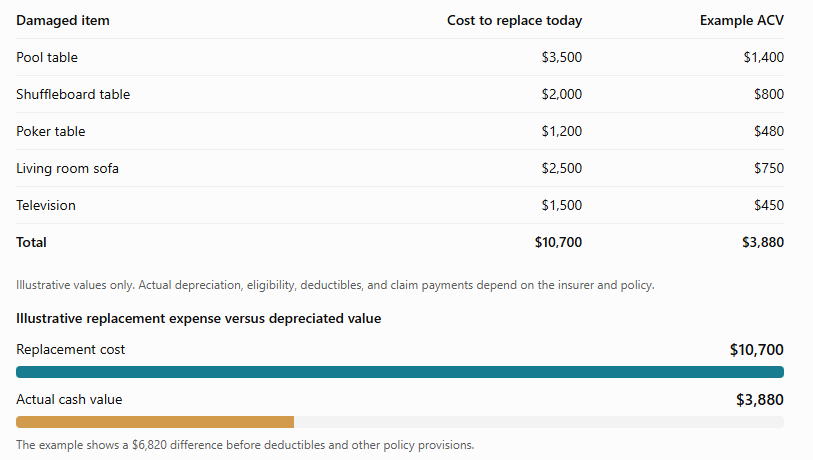
The example shows a $6,820 difference before deductibles and other policy provisions. That’s a substantial gap.
Now imagine replacing the contents of several rooms instead of five items.
The difference could become much larger.
Replacement cost coverage doesn’t guarantee unlimited reimbursement. However, it can significantly reduce the impact of depreciation after a covered loss.
Is Replacement Cost Coverage for Personal Property Automatically Included?
No. You shouldn’t assume your homeowners policy automatically includes replacement cost protection for your belongings. Some policies settle personal property claims using actual cash value.
Others include replacement cost protection or offer it through an optional endorsement. An endorsement is simply an addition or change to your insurance policy.
The details depend on your insurance company and specific contract. If those items get damaged, the owners naturally want to replace them. But without the right coverage, depreciation could reduce the insurance payment.
The important lesson?
Having homeowners insurance doesn’t automatically mean every belonging gets replaced at today’s full price.
Why Can a Cheaper Homeowners Insurance Policy Cost More Later?
A lower insurance premium can look attractive, especially when household expenses keep climbing. However, the cheapest policy isn’t always the best value.
Insurance companies may offer different combinations of coverage, deductibles, limits, and endorsements.
A policy with actual cash value protection may cost less than one offering replacement cost protection. But the difference can become noticeable after a claim.
Imagine saving money on your annual premium while unknowingly accepting reduced protection for your belongings.
Then a covered fire damages your home. Suddenly, the savings seem much smaller.
That doesn’t mean every inexpensive policy provides inadequate coverage. Nor does it mean online insurance is automatically inferior.
It means you should compare more than the premium.
The Maryland Insurance Administration encourages consumers to review coverage, exclusions, and limits instead of shopping by price alone.
What Happens When Your Pool Table or Shuffleboard Gets Damaged?
Let’s revisit the example.
Imagine you’ve owned your pool table for ten years. You paid $2,500 when you purchased it. A comparable new table now costs $3,800.
Unfortunately, a covered fire destroys it.
With actual cash value protection, your insurer may subtract depreciation from the current replacement cost.
Your payment might be considerably less than $3,800.
With replacement cost protection, the policy may provide additional reimbursement toward a comparable new table. However, the policy’s conditions still apply.
You may need to document the loss, provide replacement prices, and submit receipts. Also, replacement cost doesn’t necessarily mean you can upgrade to a more expensive model. Insurance generally aims to replace covered property with something of similar kind and quality.
So your ten-year-old pool table might qualify for a comparable new model, not necessarily the fanciest table in the showroom.
Sorry, future billiards champion.
How Does Replacement Cost Coverage for Personal Property Work During a Claim?
Replacement cost claims often involve two stages. First, the insurer determines the covered item’s actual cash value.
Then, after you replace the item and provide documentation, the insurer may release additional funds. The difference between those amounts is commonly called recoverable depreciation.
For example, suppose your damaged couch costs $2,000 to replace. The insurer initially values it at $750 after depreciation. You may receive an initial payment based on that amount, adjusted for any applicable deductible.
After buying a comparable replacement and submitting receipts, you may qualify for additional reimbursement.
Importantly, Maryland law generally provides at least two years to claim eligible replacement cost differences. Insurers may require notice of your intent to replace within 180 days.
Always review your policy’s deadlines and claim instructions.
How Can You Tell Whether Your Homeowners Insurance Includes Replacement Cost?
Start with your policy documents. Look for your declarations page, often called the dec page. This document summarizes important information, including coverage amounts and deductibles.
Next, review the personal property section and any endorsements.
Look for terms such as:
- Personal Property or Coverage C
- Replacement Cost
- Actual Cash Value
- Personal Property Replacement Cost Endorsement
- Loss Settlement
Don’t assume replacement cost coverage on your home’s structure automatically applies to your belongings. Those coverages can have different settlement provisions. If the wording seems confusing, ask your insurance agent for an explanation.
You can also request written confirmation of how your personal property would be valued after a covered loss.
How Much Personal Property Insurance Do You Need?
The right amount depends on the belongings you own and what comparable replacements would cost. Many homeowners underestimate the total value of their possessions.
Think beyond expensive electronics and furniture. Your closets, kitchen cabinets, garage, and basement contain belongings that add up quickly.
Imagine replacing every shirt, pair of shoes, kitchen utensil, towel, and piece of furniture.
The total might surprise you.
One useful exercise is to create a home inventory. Walk through each room and document what you own. Take photographs or record a video. For expensive items, keep purchase receipts and model information when available.
Store your inventory somewhere secure outside your home, such as protected cloud storage. A home inventory can make it easier to document your belongings after a covered loss.
When Should Maryland Homeowners Review Their Personal Property Coverage?
Reviewing your insurance regularly can help you catch changes before a loss occurs.
Consider checking your policy when:
- You purchase expensive furniture or electronics.
- You finish or furnish a basement.
- You add a home theater or game room.
- You inherit valuable belongings.
- You renovate or expand your home.
- Your homeowners policy renews.
You should also review your coverage after major household changes.
Maybe your once-empty basement now includes a pool table, shuffleboard, and entertainment center.
Those additions increase the value of your belongings.
Your existing insurance limits may no longer reflect what you own.
A quick conversation with your insurance agent can help identify questions worth addressing.
Why Work With an Independent Insurance Agent?
An independent insurance agent works with multiple insurance companies instead of representing only one carrier.
That means an independent agent can help compare available insurance options from different insurers. The goal isn’t simply to find the lowest price. It’s to help you understand what you’re purchasing.
For example, two homeowners policies might have similar premiums but different personal property settlement provisions. One may include replacement cost protection. Another may provide actual cash value.
An independent agent can explain those differences and help you evaluate available choices.
This can be particularly useful when insurance terminology feels confusing.
You shouldn’t need an insurance dictionary just to understand what happens to your couch after a fire.
Contact Huff Insurance for a Homeowners Insurance Review
Huff Insurance has served as an independent insurance agency since 1960. That experience gives the team a long history of helping customers understand insurance coverage and compare available options.
As an independent agency, Huff Insurance can work with multiple insurance carriers rather than offering products from only one company. The team can help explain personal property protection, policy limits, deductibles, and replacement cost options.
Whether you’re reviewing an existing policy or comparing new coverage, understanding the details matters.
Read your policy. Know how your belongings are covered before something happens.
Contact Huff Insurance to discuss your homeowners insurance and learn more about your personal property coverage options.
Frequently Asked Questions About Personal Property Insurance
1. Is replacement cost better than actual cash value?
Replacement cost generally offers broader protection against depreciation. It can help cover the current cost of comparable replacement items after a covered loss. Actual cash value accounts for age and wear, which can reduce your payment. However, replacement cost protection may carry a higher premium and additional claim requirements.
2. Does homeowners insurance replace old furniture with new furniture?
It depends on your policy’s settlement provisions. Replacement cost protection may pay for comparable new furniture after a covered loss. Actual cash value coverage generally subtracts depreciation. Deductibles, coverage limits, and replacement requirements can affect the final payment.
3. Can I add replacement cost coverage to my existing homeowners policy?
Many insurers offer personal property replacement cost endorsements or include the protection in certain policy packages. Availability depends on the insurance company and policy. Adding coverage may change your premium. Ask your agent which options are available and how they work.
4. Does replacement cost coverage pay the full amount immediately?
Not always. Some insurers initially pay the depreciated value of damaged belongings. They may release additional funds after you purchase replacements and provide receipts. Your policy explains the required documentation, deadlines, and payment conditions.
5. How do I know whether my belongings have enough insurance?
Start by estimating what replacing your belongings would cost today. Compare that amount with your personal property coverage limit. Check whether special limits apply to expensive items. An insurance agent can help explain your policy’s limits and settlement provisions.
Final Thoughts: Know What Your Homeowners Insurance Really Covers
Your home is filled with belongings that make everyday life comfortable. From your living room furniture to your basement pool table, replacing everything could become expensive.
That’s why understanding how your insurance values personal property matters.
Actual cash value and replacement cost protection can produce very different claim payments. And the difference isn’t always obvious when you’re shopping for insurance.
Before focusing only on the premium, take time to review the coverage.
Ask questions. Understand depreciation. Know your limits. Most importantly, don’t wait until something happens to discover how your belongings are insured.
Huff Insurance has helped customers navigate insurance decisions since 1960.
Contact the team to learn more about your homeowners policy and available coverage options
About The Author: Jerry Nicklow
Jerry Nicklow has worked with Huff Insuranc since 2008 and has been in the insurance industry since 1995. Jerry has written insurance marketing and educational content since joiniung Huff Insurance. He holds the API, AAI, and AIS designations from the Insurance Institutes. He has also appeared on insurance industry podcasts, like The Insurance Guys Podcast , Agency Intelligence Podcasts, and multiple insurance carrier podcasts. Jerry is also the creator of Real Insurance Talk, where he explains insurance in plain terms through articles and his YouTube channel to help individuals and business owners better understand coverage and risk.